The technical planning decisions made before deployment determine whether a private mobile network performs in the field. This page covers what needs to be modelled, how the planning process works, and what Forsk's tools provide at each stage.

Why private LTE/5G network planning is different
Unlike public mobile networks, planning a private LTE or private 5G network starts from a specific, known site (terrain, buildings, indoor structures, underground zones) and a specific set of operational requirements: which users need coverage where, which applications the network must support, and what performance and reliability thresholds are non-negotiable. In mining, utilities, airports and rail, those thresholds are often safety-critical. Accurate, simulation-based planning before deployment is how the cost of getting the design wrong is avoided.
Coverage planning for private LTE/5G networks
Coverage is the foundation of a private network plan. For private LTE and 5G deployments, it must account for outdoor terrain and clutter, indoor environments with their specific building materials and metallic infrastructure, underground and tunnel zones where standard propagation models do not apply, and the indoor/outdoor transition boundaries where gaps most often occur. Forsk's Aster and CrossWave propagation models are built for these environments — outdoor, indoor and tunnel — and can be run together across a single site. The coverage output forms the engineering specification the installation team works from; its accuracy directly determines whether the deployed network performs as required.
Capacity and interference planning
Coverage tells you where the signal reaches. Capacity planning determines whether the network can carry the traffic it will be asked to handle: defining sector sizing, carrier configuration and the frequency resources required to serve peak load without degradation. For private networks serving a known and fixed set of devices, capacity planning is more precise than in public networks, which also raises the stakes: there is no fallback to a neighbour cell if capacity is exhausted. On shared spectrum or multi-network sites, interference management is equally critical. The frequency plan must be validated against the actual site geometry to confirm acceptable interference levels across all operating conditions.
Private LTE/5G network
The decisions made before deployment determine the planning requirements at every subsequent stage. Technology (LTE, 5G NR or dual-mode) sets the frequency planning and propagation modelling requirements. Spectrum choice (licensed, shared (CBRS, 3.5 GHz) or unlicensed) determines the interference coordination approach. Core configuration — on-premise, cloud or hybrid — affects latency, data sovereignty and backhaul design. These decisions are expensive to reverse after procurement and installation begin.
Indoor and outdoor private network design
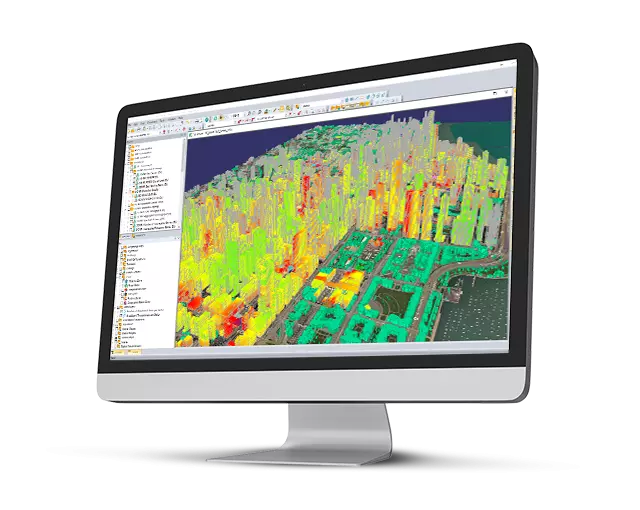
Most industrial private network sites are not purely indoor or purely outdoor. An airport terminal sits within an airside operational zone. A mine has surface infrastructure connected to underground tunnels. A smart factory has production buildings surrounded by logistics yards. Designing a network that performs reliably across all zones requires a planning tool that handles indoor and outdoor environments in a single workflow, with propagation models calibrated for each. Atoll One supports combined indoor and outdoor planning in a single project, producing a unified deployment specification across all coverage zones without manual reconciliation between separate tools.
Planning for mission-critical and industrial environments
Private LTE/5G networks in industrial environments carry applications where network failure is an operational or safety event, not an inconvenience. Forsk's tools are used across the most demanding private network environments — mining sites with underground tunnels and autonomous vehicles, utility networks spanning distributed grid infrastructure, airports with layered indoor and outdoor operational zones, smart factories with dense metallic environments and robotic production lines, and rail networks undergoing the GSM-R to FRMCS migration. Each vertical has specific planning requirements that generic tools are not calibrated for.
Private cellular network architecture
Private cellular networks involve more design decisions than Wi-Fi deployments. Before deployment begins, the engineering team must define:
- Spectrum allocation and band selection (licensed, shared, or unlicensed)
- Core network configuration (on-premise, cloud, or hybrid)
- Radio access technology: LTE, 5G NR, or dual-mode
- Number of cells, antenna placement, and sector configuration
- Indoor and outdoor coverage zones and their boundaries
- Backhaul connectivity for remote or distributed sites
Each of these decisions affects coverage, capacity, and interference. Getting the architecture wrong at the planning stage is expensive to fix after deployment. Simulation-based planning reduces that risk by validating the design against the actual site before installation.
Private network coverage planning
Coverage planning for private networks must account for the full operating environment. This is rarely straightforward. Industrial sites combine outdoor terrain with large, complex indoor structures, metallic obstacles, underground zones, and areas with dense user concentrations. Forsk's propagation models, including Aster and CrossWave, are designed for these environments. They handle outdoor macro coverage, indoor signal penetration, tunnel propagation, and the interaction between layers. Coverage planning produces the antenna placement, tilt, and power configuration that the engineering team installs on site.
How Atoll One supports the private LTE/5G planning workflow
Atoll One is Forsk's private mobile network planning tool, designed for site-level private LTE and private 5G deployments. It brings outdoor macro planning, indoor in-building planning and the environments between them into a single workflow with propagation models calibrated for industrial environments, tunnels and complex indoor spaces, LTE and 5G NR planning including dual-mode configurations, capacity and traffic modelling by zone, interference analysis and frequency planning, and deployment-ready output: antenna configurations, cell plans, coverage maps and technical specifications. It is used by system integrators, private network operators and RF engineering teams.
When Atoll and Atoll One are needed together
For most site-level private network deployments, Atoll One provides the full planning capability required. Atoll is needed for deployments that span multiple sites, require national-scale coverage modelling, involve complex multi-technology configurations, or need deep customisation through scripting and API access. For example, national rail or utility networks, multi-site deployments with inter-site coordination, or operators already running Atoll for MNO work who are extending into PMN. Many organisations use Atoll One for private network projects and Atoll for their public network or large-infrastructure work. Forsk supports both.
Private mobile network planning by vertical: utilities, mining, rail, airports, manufacturing
Private mobile networks look different depending on the industry. The planning requirements (environment, use case, coverage zones, reliability standards) vary significantly across verticals.
Mining
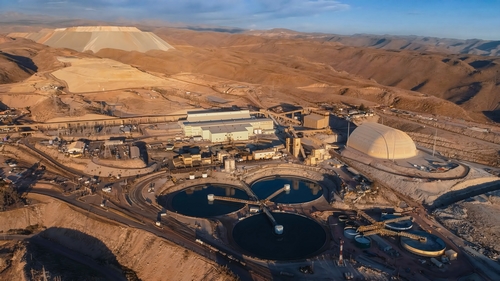
Some of the most complex PMN environments: open-pit terrain, underground tunnels, evolving site layouts, and safety-critical applications. Autonomous vehicles, remote operations, and worker safety systems all depend on network reliability.
Airports

Terminals, hangars, ramps, and outdoor operational zones require layered indoor and outdoor coverage. Ground operations, baggage systems, aircraft turnaround, and security communications run on private cellular.
Manufacturing & Smart factories

Dense metallic environments, robotic production lines, AGVs, and industrial IoT require deterministic, high-reliability connectivity. Planning must account for RF complexity created by machinery and building materials.
Rail & FRMCS

Continuous trackside coverage, high-speed mobility, tunnels, and the GSM-R to FRMCS migration make rail one of the most technically demanding PMN environments. Explore rail and
Utilities

Wide-area coverage across substations, field assets, & remote infrastructure. Grid monitoring, SCADA, & worker safety communications require reliable, low-latency connectivity across geographically distributed sites.