Oil and gas operations run across some of the most difficult and hazardous environments anywhere. Private LTE and 5G give operators the dedicated, secure infrastructure that upstream, midstream and downstream work depends on. Getting it right means modelling the full environment before a single antenna goes in.
Why oil and gas operations need private LTE/5G networks
Public mobile networks don't reach most oil and gas sites. Remote upstream locations, offshore installations and pipeline monitoring points across open or mountainous terrain have no coverage at all. Where public coverage does exist, it can't guarantee the security, reliability or latency that SCADA, safety communications and operational control need.
A private LTE or 5G network gives the operator full control: dedicated spectrum, a private core, and coverage shaped entirely around the operational footprint.

LTE remains the dominant deployed technology in oil and gas, driven by a mature hardware ecosystem and proven reliability in demanding outdoor environments. Private 5G is growing for high-density refinery environments and sites requiring ultra-low latency for industrial automation and remote operations. Offshore operators in some regions also hold dedicated spectrum in the 700 MHz and 900 MHz bands specifically for private offshore networks, reflecting how established private cellular has become across the sector, onshore and offshore alike.
Mission-critical voice and alerting over private LTE and 5G is underpinned by the 3GPP MCX (Mission-Critical Services) standard, which defines the quality-of-service and flow-prioritisation behaviour needed for push-to-talk, group calls and emergency alerts to work reliably under network load, which is the same standard that lone-worker and incident-response systems in the sector are increasingly built on.
The challenge of private network planning for oil and gas companies
Oil and gas sites don't have a single RF environment. An upstream field is a mix of open terrain, temporary infrastructure, wellhead equipment and remote monitoring points, often without terrain data at usable resolution. A midstream pipeline corridor crosses plains, hills, river crossings, and urban and rural stretches all at once. A refinery is a dense industrial environment of metallic structures, process vessels, high-attenuation buildings and outdoor zones that all ne to be within coverage.
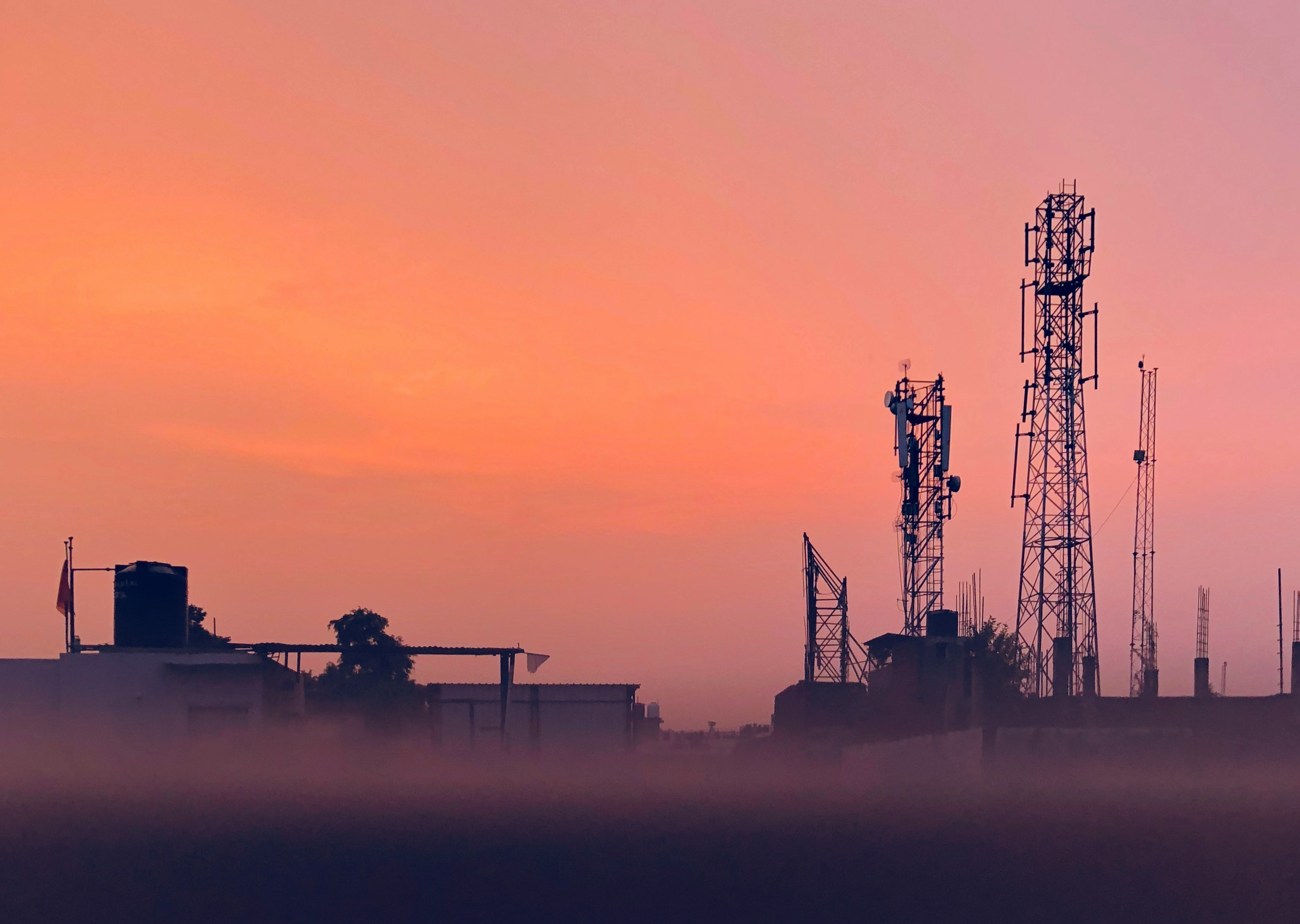
Planning a private wireless network here means accurate modelling simultaneously across outdoor terrain, indoor and semi-indoor structures, and at every boundary. Get base-station placement, backhaul or antenna configuration wrong during planning and you're left with coverage gaps that are expensive and disruptive to fix once the site is live and under strict safety and permitting rules.
Much of that equipment also sits inside classified hazardous areas: ATEX Zone 1 and Zone 2 in Europe, or regional equivalents, where only equipment must be certified, and zone boundaries are a planning constraint, not just an RF characteristic. The same dense metal structures block GPS, which is exactly where personnel tracking and emergency mustering have to rely on the private network itself, not satellite positioning, to locate a worker.
What the network must support:
- SCADA and operational control
- Pipeline monitoring and integrity management
- Field crew communications
- Refinery and processing plant operations
- HSE and safety systems
- Hazardous zone compliance
- Remote operations and automation
Planning oil and gas private networks with Atoll and Atoll One
An oil and gas operator's planning needs run from wide-area field networks to individual sites. Atoll and Atoll One cover both ends.
Atoll handles large-scale, geographically dispersed networks: upstream fields and drilling sites, pipeline corridors planned as linear routes, and multi-site operations across a regional or national footprint. Its propagation modelling, automatic cell planning and carrier-grade reliability hold coverage together across vast, remote areas.
Atoll One handles site-level work: refineries, processing plants, compressor stations and individual sites like well pads and storage facilities, indoor and outdoor together. Rather than a separate project per structure, it models multiple buildings and their surrounding outdoor zones — control rooms, process units, storage tanks, pipe racks — in one project, so coverage can be validated across the whole site, including the boundaries between structures.
Where civil or structural designs already exist in CAD or BIM tools, Atoll One imports building geometry directly through the open IFC format, rather than rebuilding it by hand. That matters most in refinery and plant environments, where the structural data usually already exists on the engineering side.
Most operators pick the tool that fits their primary use case — Atoll for nationwide or multi-site planning, Atoll One for site-level design — though the two work together where a deployment spans both scales.
Frequently asked questions
Public networks do not cover most upstream, midstream and offshore environments, and where they do, they cannot guarantee the security, reliability or latency that operational and safety systems require. A private LTE or 5G network gives the operator a dedicated wireless infrastructure: spectrum, coverage and security configured for the operational environment, independent of public carrier availability.
SCADA and operational control, pipeline monitoring and integrity management, field crew communications, refinery and plant operations, HSE and safety systems including GPS-independent personnel tracking, hazardous zone (ATEX/Zone 1/Zone 2) compliance, and remote operations and drone-based inspection. The common thread is that all of these require reliable connectivity at locations and reliability levels that public networks cannot provide.
LTE remains the dominant deployed technology in oil and gas, with a mature hardware ecosystem suited to outdoor industrial environments. Private 5G adoption is growing for refinery and processing plant environments requiring higher bandwidth, lower latency or denser device populations. Many operators deploy LTE for wide-area field coverage and evaluate 5G for specific site-level applications.
The combination of scale and environment diversity. A single operator may need to plan a network across an upstream field in remote terrain, a pipeline corridor spanning hundreds of kilometres, and a refinery with complex indoor and outdoor coverage requirements — often as part of a unified network. Each environment has different propagation characteristics and reliability requirements. Planning must account for all of them accurately.
Atoll is designed for wide-area field networks: upstream areas, pipeline corridors, multi-site operations spanning large geographic footprints. Atoll One is optimised for site-level deployments: refineries, processing plants, compressor stations, individual operational sites. Most operators select one tool based on their primary use case, though both can address different aspects of network planning depending on the scope of the deployment.