Private LTE/5G for Mines: Planning is the Key to Success
The hidden risks of poor connectivity
A dead zone in your mine is more than an inconvenience. There is a possibility that this could have a negative impact on safety, efficiency and profit. Private LTE/5G networks have the potential to resolve this issue, but only if they are planned correctly.
Mining operations depend on real-time connectivity for all essential functions, including tracking workers and equipment, operating autonlyomous haulage, monitoring underground air quality, and maintaining communication across sites that span kilometres of open pit and hundreds of metres of tunnel. Legacy systems — Wi-Fi deployments, LMR radio networks, and fragmented SCADA infrastructure — were not designed to meet these demands. Private LTE (Long-Term Evolution) and 5G networks deliver the reliability, security and low latency that mission-critical mining operations require. These networks are unified on a single infrastructure rather than a patchwork of incompatible systems.
However, the efficacy of the technology is contingent on the quality of the planning process. If a private network is deployed without taking into account the specific geometry of a mine, how it changes over time, and the environments it needs to serve, coverage failures will occur that cannot be rectified by additional hardware. Achieving safety, efficiency and cost savings is dependent on effective planning prior to installation of the first antenna.
The three biggest connectivity challenges in mining
The following text outlines the three most significant challenges related to connectivity in the mining industry.
“We have encountered an issue with our signal strength dropping in the pit.”
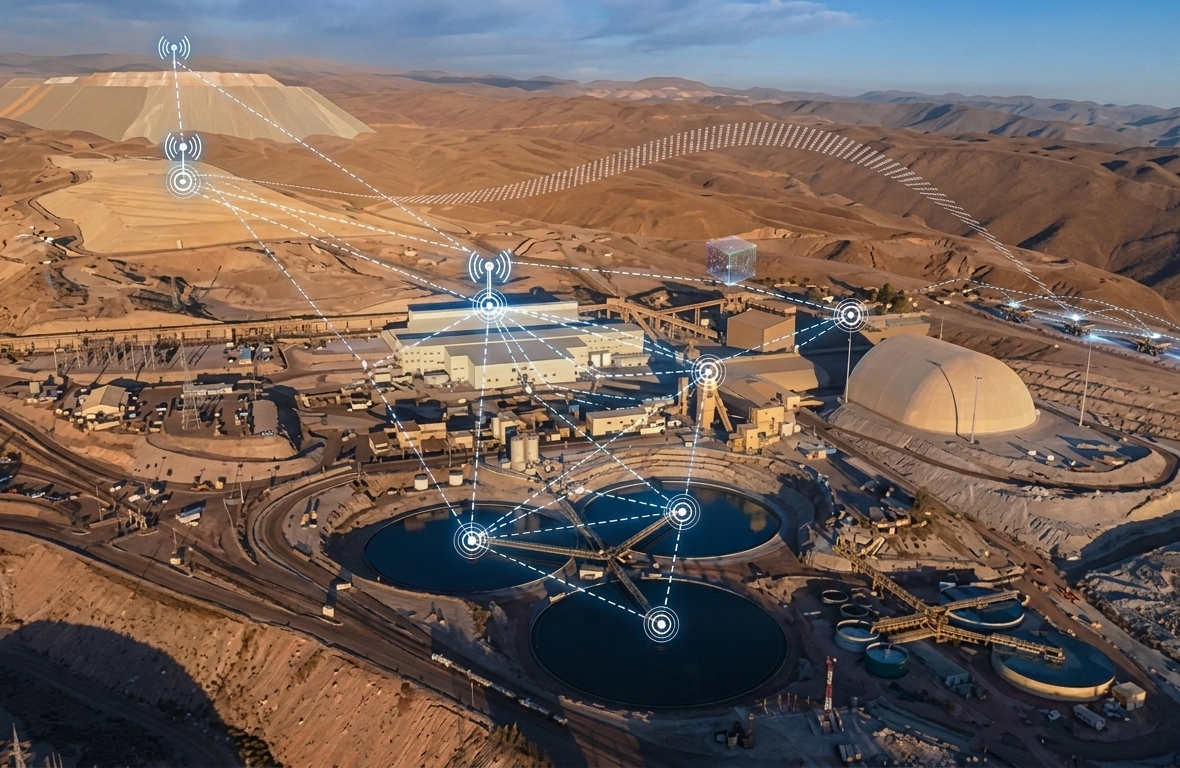
Open-pit mines are not static environments. Pits are deepened, haul roads are shifted, new benches are cut, and heavy equipment moves continuously. It is important to note that any change to the physical environment will also change the radio environment. The signal propagation process in an open pit is influenced by the terrain characteristics, including gradients, walls, and the excavation's geometry. A network that was well-designed at commissioning can have significant coverage voids six months later, when the pit has advanced and the geometry no longer matches the original design.
There are three planning disciplines that address this issue. Firstly, terrain-aware modelling involves importing the mine's own engineering data — GIS exports, ISO contours, lidar surveys — into a radio planning tool to generate accurate coverage predictions that can be updated as the excavation progresses. Atoll is a wireless network planning tool that enables planners to work from terrain data. As outlined in a recent Forsk webinar on private network planning for mines: Atoll allows you to leverage terrain data to model and update the mine over time, eliminating the need for manual drawing. Secondly, modular base stations can be repositioned as the pit expands, rather than fixed infrastructure being locked to a geometry that will not last. Thirdly, we recommend mounting equipment on existing site structures, such as light poles and haul road gantries, rather than introducing new structures that add cost and deployment time.
"Our underground tunnels are a black hole for signal"
The issue is wholly different when it comes to subterranean systems. Wi-Fi has no effective range in a tunnel environment; standard radio cannot penetrate the rock between headings. The result is a network blackout in areas where continuous monitoring of ventilation, gas concentrations and worker location is most critical from an operational and legal standpoint.
The solution is radiating cable, which is a coaxial cable engineered to emit signals along its entire length. It is run through tunnels and fed from base stations at access points. Small cells are installed at junctions, chambers, and key intersections. Collectively, these systems ensure uninterrupted coverage throughout the underground network. Planning the deployment is complicated by geometry: mining tunnels are not straight corridors. The subject under discussion here is one that is constantly evolving and changing, with new information and perspectives being added regularly. Ventilation shafts, a feature of all underground mines, also play a role in the design. They provide vertical pathways between levels and the surface, enabling fibre or wireless backhaul without the need for separate infrastructure. Incorporating the full three-dimensional structure of the underground environment into the planning model at the outset, including all tunnel geometry, chambers and ventilation routes, is essential for validating coverage before installing a single cable.
"The topography of our mine site changes on a monthly basis; our network can't keep up"
This is the challenge that receives the least attention in deployment announcements, yet it often poses the most significant operational difficulties after go-live. Mine development is a well-managed process, with new levels approved, tunnels advancing and pit extensions programmed in accordance with schedule. The network originally commissioned for the mine may not be suitable as the mine becomes operational.
From the outset, effective planning for change entails the selection of infrastructure capable of mobility, such as modular base stations and repositionable repeaters, as opposed to permanent installations sized to a fixed layout. It also means using digital twin modelling to test coverage for planned tunnel advances or pit extensions before the ground moves: a new heading that appears on the mine plan in month three can have its network requirements validated and equipment pre-positioned in month two. Maintaining the coverage model on the same update cycle as the mine plan converts what is usually a reactive exercise into a proactive one. As Scott Pereira of Forsk noted during the same webinar: “It is important to note that a single coverage gap has the potential to halt production, resulting in costs of millions per hour – or even more severe consequences.”
The Business Case: How Smart Planning Makes a Difference
The business case for rigorous planning in mining operations is based on three key outcomes that can be measured in a quantifiable way.
In terms of safety, a well-planned network ensures continuous monitoring of environmental conditions, equipment health, and worker location – both underground and on the surface. It is important to note that ventilation monitoring systems, gas detection sensors and emergency communication channels only deliver their safety value when coverage is reliable and continuous. A planning failure that results in a new heading without signal is not an IT problem; it is an operational risk.
In terms of efficiency, autonomous haulage fleets, remote drilling systems and IoT-enabled predictive maintenance all operate on the assumption of network availability. Unplanned connectivity loss directly results in production loss. The network was designed with the mine's geometry in mind at the time of commissioning. As the environment evolves and diverges from the original design, the network will generate an increasing number of these stops over time.
In terms of cost, there is a notable discrepancy between the planning investment and remediation costs. Identifying and correcting a coverage gap in a propagation model before deployment is a desk exercise. Identifying the issue after an outage is a different order of expenditure. Robust pre-deployment simulation has been shown to reduce the number of field surprises, and with them the unplanned costs that follow.
Lessons from the Field: What Mines Get Wrong
Five patterns recur in mining connectivity deployments that run into difficulty.
1. Treating private LTE/5G like Wi-Fi. The hardware looks similar to a non-specialist, but the planning discipline is not. Private LTE/5G is carrier-grade infrastructure, and it needs to be approached as such, designed with the same rigour as a mobile operator's network, not provisioned as an IT upgrade. Mines that treat it as an afterthought tend to encounter problems that careful upfront planning would have caught.
2. Ignoring underground coverage until it becomes a problem. Underground connectivity is often scoped as a follow-on project once the surface network is running. In practice, the two need to be planned together: they share backhaul infrastructure, spectrum planning, and in many cases physical routing through ventilation and access shafts. Separating the planning creates integration gaps that are expensive to resolve later.
3. Assuming the network will hold as the mine expands. A go-live is not a finished product. A mine is a moving environment, and a network designed for a fixed layout will degrade as that layout changes. Mines that do not maintain the coverage model as a live document are managing their network reactively rather than proactively.
4. Not involving operations teams in the planning process. Network planners need to know where the mine is going, not just where it is. Development schedules, planned tunnel advances, and pit extension programmes are the inputs that allow a network design to account for future requirements. That information lives with mine planning and operations, not with telecoms teams. Connectivity planning that happens in isolation from operations planning will be surprised by the mine.
5. Skipping simulation. Pre-deployment propagation modelling (running coverage predictions against the mine's actual terrain and tunnel data before equipment is installed) surfaces voids, validates base station and radiating cable placement, and identifies design problems at the stage when they are cheapest to fix. Mines that bypass this step in the interest of speed encounter the same problems later, at considerably greater cost and operational disruption.
The Future of Mining Connectivity
Private LTE/5G is establishing itself as the standard for mining connectivity: a single, reliable network capable of carrying safety systems, autonomous operations, and operational data across both surface and underground environments simultaneously. For mines investing in this infrastructure, technology is no longer a limiting factor.
The key differentiator between successful and unsuccessful deployments is the quality and continuity of the planning process. Mines that model their networks against the terrain they are building, plan their underground coverage before the tunnels advance, and treat the coverage model as a living document will see fewer unplanned outages, lower maintenance overhead, and more reliable safety systems.
Prior to undertaking any further expansion, it is advisable to conduct a coverage simulation. The issues it highlights are more straightforward to address on a screen than they are underground.